
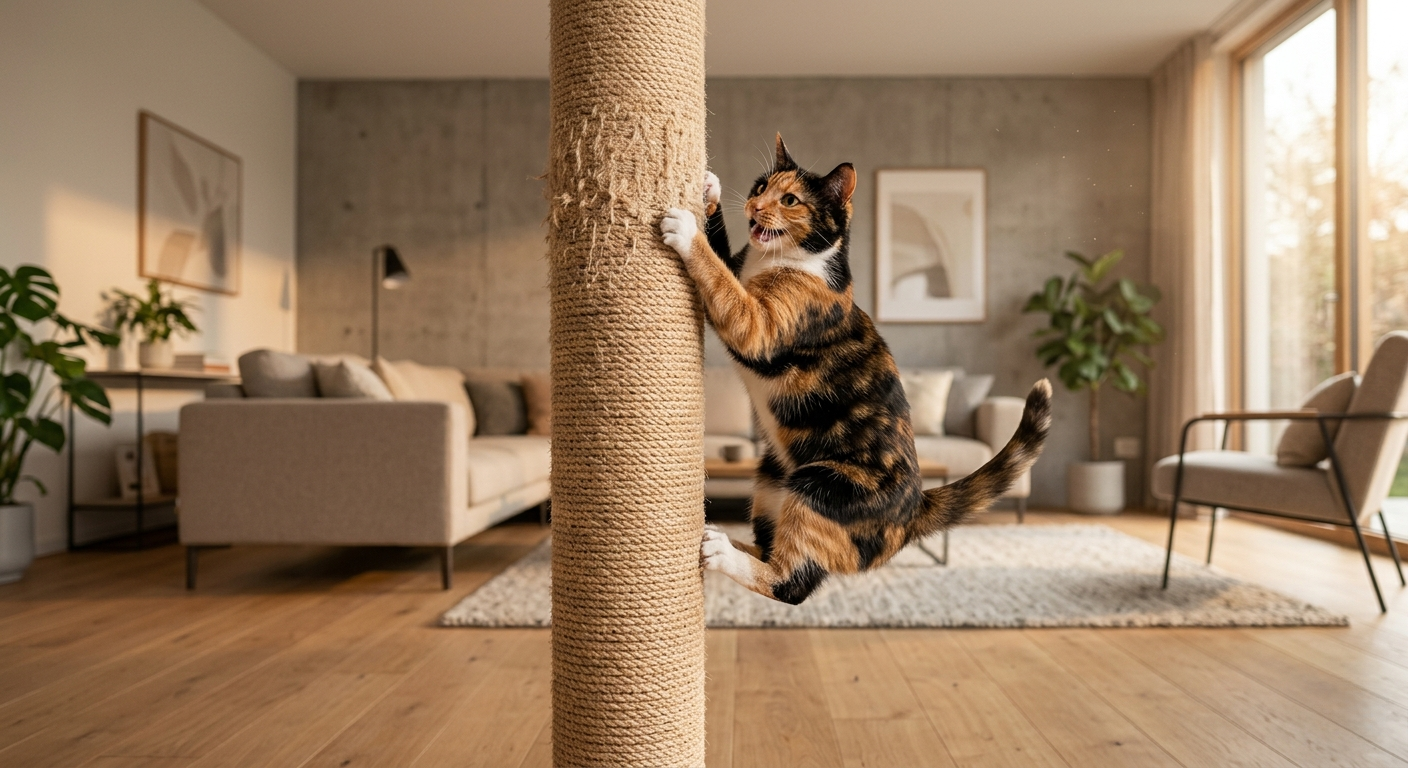
Cats scratch. This is not a behavioral problem, a character flaw, or something that can be trained out of a cat — it is as fundamental to feline biology as hunting and grooming. Scratching serves multiple essential functions: it removes the dead outer sheath of the claws, stretches the muscles and tendons of the forelimbs and back, deposits scent from glands in the paw pads as a territorial marker, and provides visual marking through the physical grooves left in the scratched surface. A cat that does not scratch is a cat that is physiologically unable to, not a cat that has been successfully trained out of scratching. The solution to furniture destruction is never to eliminate scratching but to provide surfaces the cat prefers to scratch over your furniture. This guide gives you the complete strategy.
Understanding Why Your Cat Chooses Your Furniture
Before implementing solutions, understanding what makes your furniture attractive for scratching helps you provide alternatives that are genuinely more appealing:
- Location: cats prefer to scratch in socially significant locations — near sleeping areas, near entrances to rooms, and in visible, central locations. Your corner sofa is attractive because it is in the most used room of your home, which makes it an ideal territorial marker. A scratching post hidden in a back bedroom is less appealing.
- Texture: most cats prefer surfaces with vertical grain or fiber they can really sink their claws into — sisal rope, corrugated cardboard, and bark have this quality. Soft upholstery fabrics provide a satisfying drag resistance for scratching.
- Orientation: cats have preferences for vertical versus horizontal scratching. Cats that scratch sofa arms and chair backs prefer vertical scratching; cats that scratch carpets or rugs prefer horizontal scratching. Observe your cat’s preference and provide accordingly.
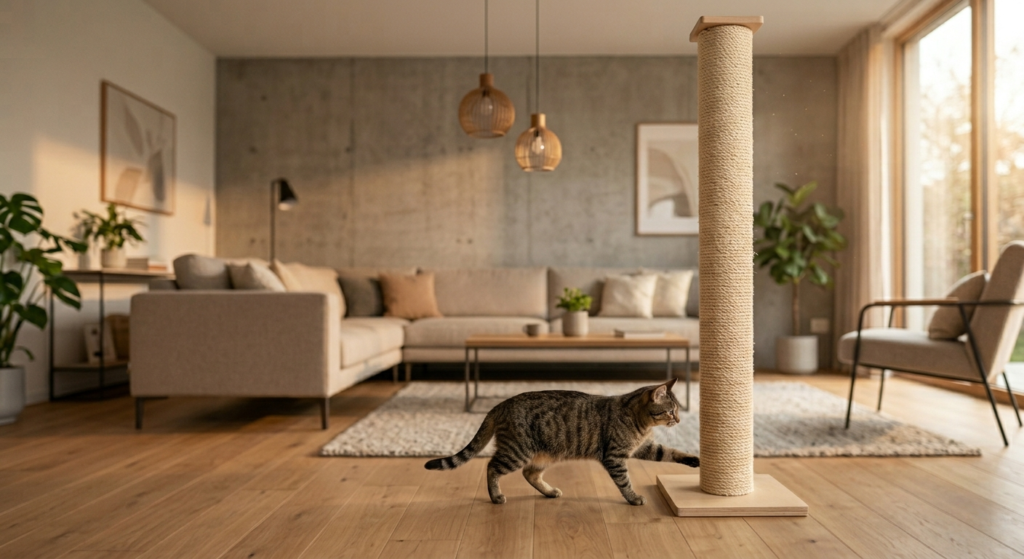
- Height: for vertical scratching, the post must be tall enough for the cat to fully extend their body during scratching — typically at least 32 to 36 inches for an adult cat. Short scratching posts that do not allow full extension are often rejected because they cannot serve the full stretch function.
- Stability: a wobbly scratching post that tips when the cat leans into it is almost universally rejected after the first experience. Stability is non-negotiable.
Providing Irresistible Scratching Alternatives
Choosing the Right Scratching Post
- Material: sisal rope (the most universally preferred texture), sisal fabric, corrugated cardboard, and natural bark are all excellent. Carpet-covered posts are less preferred by many cats and may actually teach the cat that carpet is an acceptable scratching surface.
- Height: minimum 32 inches for medium to large cats. Taller is better — a post that reaches from floor to ceiling is ideal for breeds like Maine Coons.
- Base stability: the base must be wide and heavy enough that the post does not tip when the cat puts their full weight into it. Test it yourself by pushing firmly with your hand — if it rocks, it will be rejected.
- Multiple posts: provide at least one scratching surface per cat, plus one additional — positioned in different locations around your home.
Strategic Placement: The Key Variable
This is where most owners go wrong. A scratching post placed in an unused corner of a spare room will be ignored regardless of its quality. Scratching posts must be placed where your cat already wants to scratch:
- Place a scratching post directly next to or in front of the furniture being targeted — this redirects the behavior to the correct surface in the location the cat has already identified as desirable
- Place posts near sleeping areas — cats typically scratch immediately after waking to stretch and mark
- Place posts in visible, central locations in the main living areas — the cat needs to be able to see and access them easily during their normal daily activity patterns
Deterring Furniture Scratching Effectively
Once you have provided excellent alternatives in the right locations, make the targeted furniture less appealing:
- Double-sided tape: cats strongly dislike the sticky texture on their paws. Apply to targeted furniture surfaces temporarily — after the cat has been consistently using the scratching post in the same area for several weeks, you can remove it. Furniture Defender and Sticky Paws are purpose-made products.
- Aluminum foil: the texture and sound are aversive to many cats. Drape over targeted surfaces temporarily.
- Commercial cat deterrent sprays: products containing citrus or bitter scents that cats find aversive. Reapply every few days as the scent fades. Test on an inconspicuous area first as some sprays can affect fabric.
- Vinyl furniture protectors (Sofa Scratcher Shield): clear plastic panels that attach to the corners and arms of upholstered furniture. Completely block access to the fabric while being virtually invisible.
- Furniture covers: slipcovers or furniture throws on targeted pieces reduce the accessible surface while the cat is redirected to appropriate alternatives.
Positive Reinforcement: Teaching the Correct Behavior
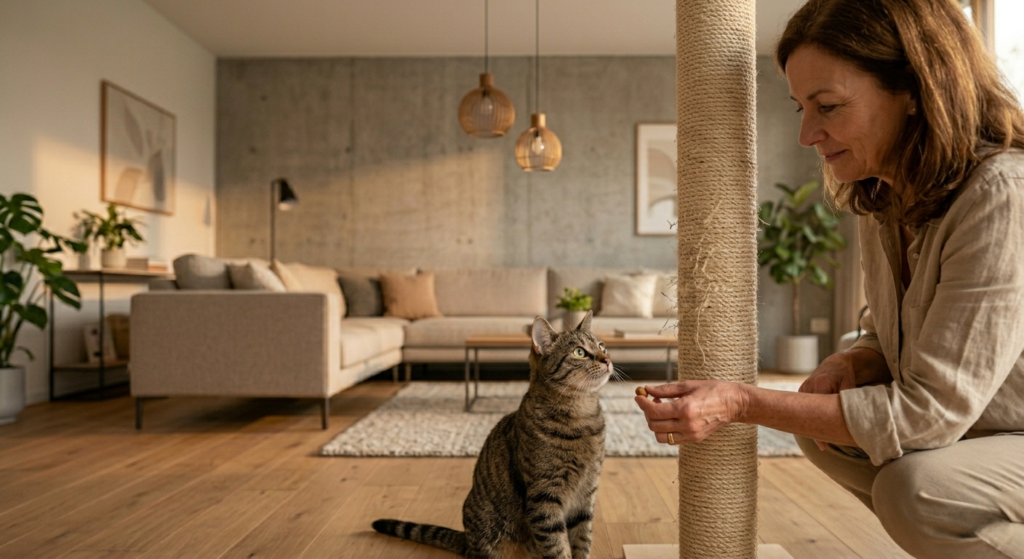
Deterring the wrong behavior must always be paired with rewarding the correct behavior. Every time your cat uses the scratching post instead of the furniture:
- Reward immediately with a high-value treat
- Use calm, warm verbal praise in a consistent tone
- Consider using catnip: sprinkling catnip on a new post or rubbing a catnip toy against it significantly increases a cat’s interest in investigating and using the post
- Play with a wand toy near the post, directing the cat’s paws toward the surface during play
- Never punish scratching: punishment does not teach the cat where to scratch — it only makes the cat more anxious and potentially more inclined to scratch in stress-related ways in your absence
Nail Trimming: Reducing Damage Between Sessions
Regular nail trimming every two to three weeks significantly reduces the damage done when scratching occurs on inappropriate surfaces. It does not stop scratching behavior, but it limits the physical impact on furniture while you work on the behavioral redirection. Trim only the clear hooked tip — never into the pink quick. Most cats accept nail trimming readily when introduced gradually with positive reinforcement from kittenhood.
Soft Nail Caps: A Temporary Solution
Soft vinyl nail caps (Soft Paws) glued over the cat’s claws are an option for severely destructive situations. They are attached by a veterinarian or groomer and last two to six weeks before falling off naturally as the claw grows. They allow normal scratching behavior without the physical damage. They require reapplication every four to six weeks, and some cats object to wearing them initially. They are not a long-term substitute for providing appropriate scratching surfaces and positive redirection.
Frequently Asked Questions
Should I declaw my cat to stop scratching?
Declawing (onychectomy) involves the amputation of the last bone of each toe — it is not simply nail removal. It is banned or strongly discouraged by veterinary organizations in many countries and causes permanent pain, altered gait, and psychological distress in many affected cats. The behavioral and management solutions in this guide eliminate the need for declawing in virtually every case.
My cat ignores the scratching post I bought. Why?
The most common reasons: the post is too short to allow full body extension, it is wobbly, it is in an undesirable location (away from where the cat wants to scratch), or the material is not appealing. Try moving the post to the location being scratched, adding catnip, and ensuring the post is tall and completely stable.
How long does it take to redirect a cat’s scratching?
With the correct post in the correct location, backed by positive reinforcement, most cats begin using the new surface within one to two weeks. Some cats require a month or more of consistent management. The timeline depends on how ingrained the furniture scratching habit is.
My kitten has started scratching furniture. How do I address it before it becomes a habit?
Now is the best time to establish correct scratching habits. Place a scratching post in every room the kitten accesses, make furniture unappealing with double-sided tape immediately, and reward every use of the post. Habits formed in kittenhood are far easier to establish than habits reformed in adult cats.
Conclusion
Furniture scratching is solvable in the vast majority of households without punishment, without declawing, and without significant expense. The formula is straightforward: provide multiple excellent, appropriately sized, and strategically placed scratching surfaces, temporarily deter the targeted furniture, and reward the correct behavior consistently. Most cats redirect within weeks when this approach is applied correctly. Understanding that scratching is a need to be met — not a behavior to be eliminated — is the shift in perspective that makes the solution obvious.