
Indoor cats live safer, longer lives than outdoor cats — but safety without enrichment is not the same as wellbeing. In their natural environment, cats spend up to twelve hours per day engaged in hunting, stalking, patrolling, exploring, and interacting with a complex and constantly changing world. An indoor environment that offers none of these experiences forces cats into a life of chronic understimulation — which shows up as excessive sleeping, overeating, attention-seeking, aggression, or destructive behavior. The encouraging reality is that enriching an indoor cat’s environment does not require expensive equipment or significant time investment. It requires understanding what cats actually need and providing it creatively. Here are fifteen proven approaches.
Why Enrichment Is a Welfare Issue, Not Just Entertainment
Before the ideas, the reasoning: research in feline behavioral science consistently shows that environmental enrichment produces measurable improvements in physiological stress markers (cortisol levels), behavioral indicators of wellbeing, and immune function in confined cats. A 2018 study found that cats in enriched environments showed significantly lower rates of upper respiratory infection during stressful events compared to cats in standard housing. Enrichment is not a luxury. For an indoor cat, it is as fundamental to health as appropriate nutrition.
The 15 Best Indoor Cat Enrichment Ideas
1. Daily Interactive Wand Toy Sessions
Nothing replaces active, owner-led play with a wand toy for meeting a cat’s hunting drive. Two sessions of 10 to 15 minutes daily — one in the morning and one in the evening — is the minimum foundation of indoor cat enrichment. Move the toy like real prey: erratic, stopping, hiding under fabric, running away. Always end by letting the cat catch the toy to complete the hunt sequence.
2. Window Perch Plus Outdoor Bird Feeder
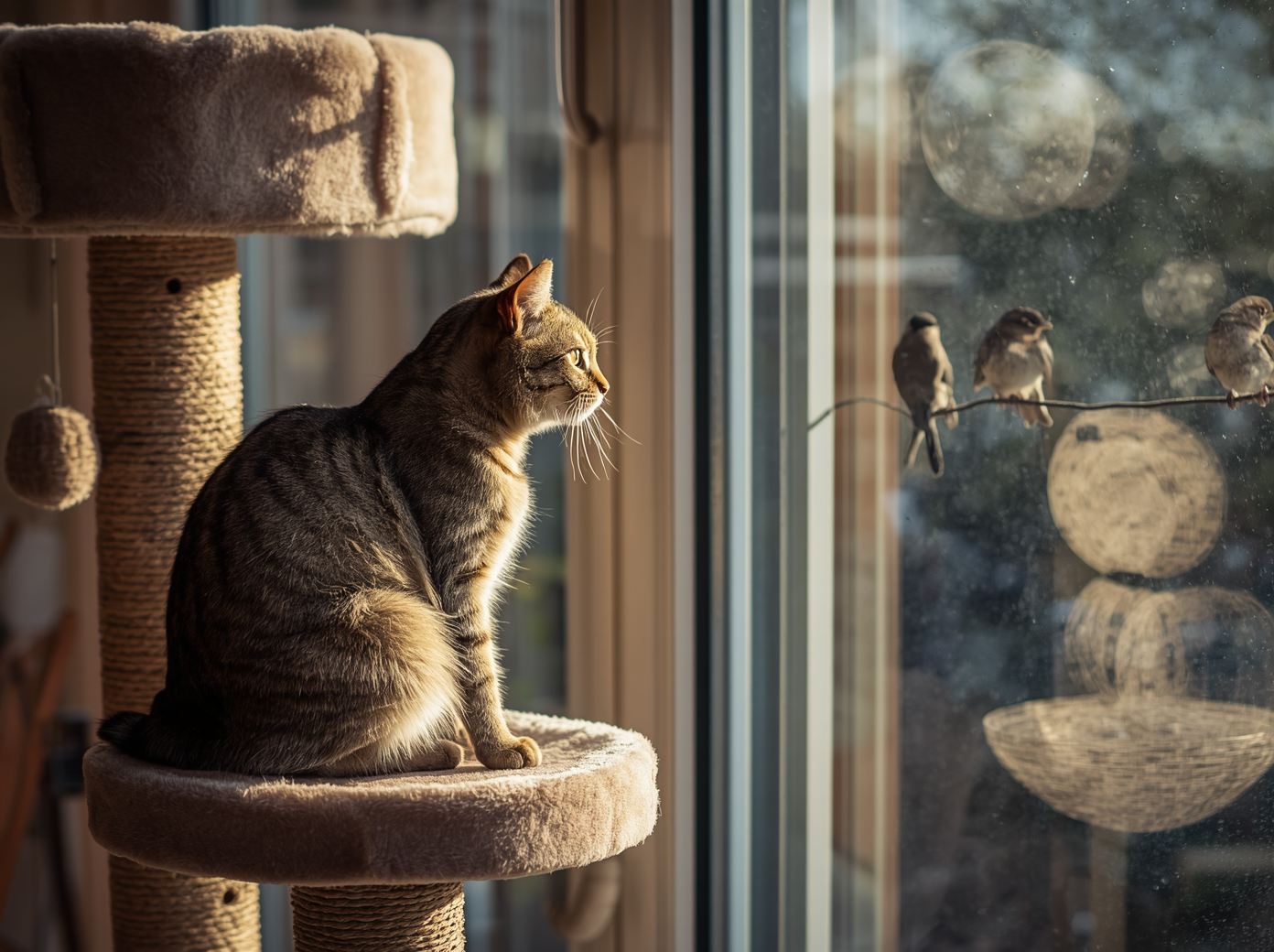
Installing a bird feeder, bird bath, or squirrel feeder visible from your cat’s favorite window creates hours of daily enrichment at virtually no cost. Bird activity provides movement, sound, and the stimulation of potential prey in a safe, frustration-free format. A comfortable window perch — installed at the right height — makes the viewing position more sustainable and signals to the cat that this is their watching spot.
3. Cat TV: Videos Designed for Cats
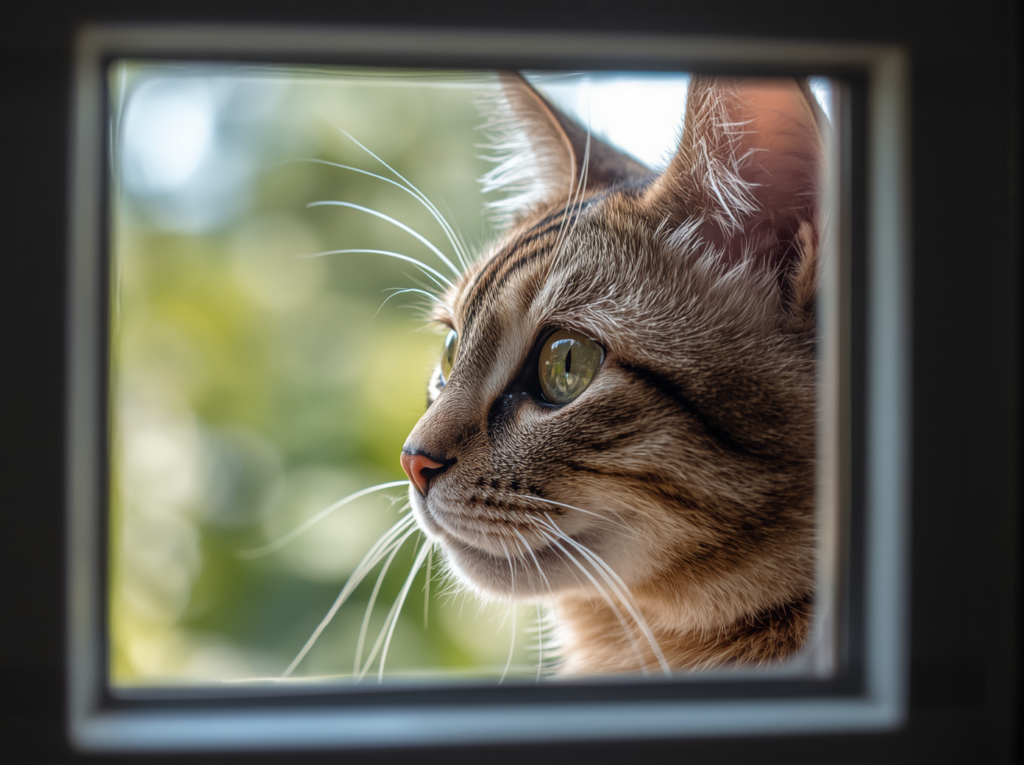
YouTube and streaming services offer hours of videos specifically produced for cats — featuring birds, squirrels, fish, and insects filmed at cat-eye level with accompanying natural sounds. Many cats engage enthusiastically for extended periods. Play these on a tablet or laptop placed at floor or furniture level for best engagement.
4. Food Puzzle Feeders
Replace at least one daily meal with a food puzzle feeder. The mental engagement of working to release food is profoundly satisfying for cats, and the extended duration of the activity (20 to 45 minutes versus 30 seconds from a bowl) significantly increases daily cognitive engagement.
5. Hide-and-Seek Feeding
Hide small portions of dry food or treats in different locations around your home before your cat’s scheduled meal time. Your cat must use their nose and memory to find all the caches. This turns the entire home into an enrichment environment and meets the foraging drive that cats retain regardless of how many generations they have lived indoors.
6. Cat Tunnel and Crinkle Toys
Fabric tunnels — available inexpensively from any pet retailer — provide hiding, stalking, and movement opportunities. The crinkle material in most tunnels adds an auditory dimension that many cats find irresistible. Connecting multiple tunnels creates a more complex exploration environment.
7. Cardboard Box Rotation
Free, universally available, and genuinely exciting to cats — a new cardboard box placed in a room immediately attracts most cats for investigation, hiding, and scratching. Rotate boxes regularly so there is always something slightly new in the environment. Cut additional holes in larger boxes to create peek-through ports.
8. Cat Tree With Multiple Levels
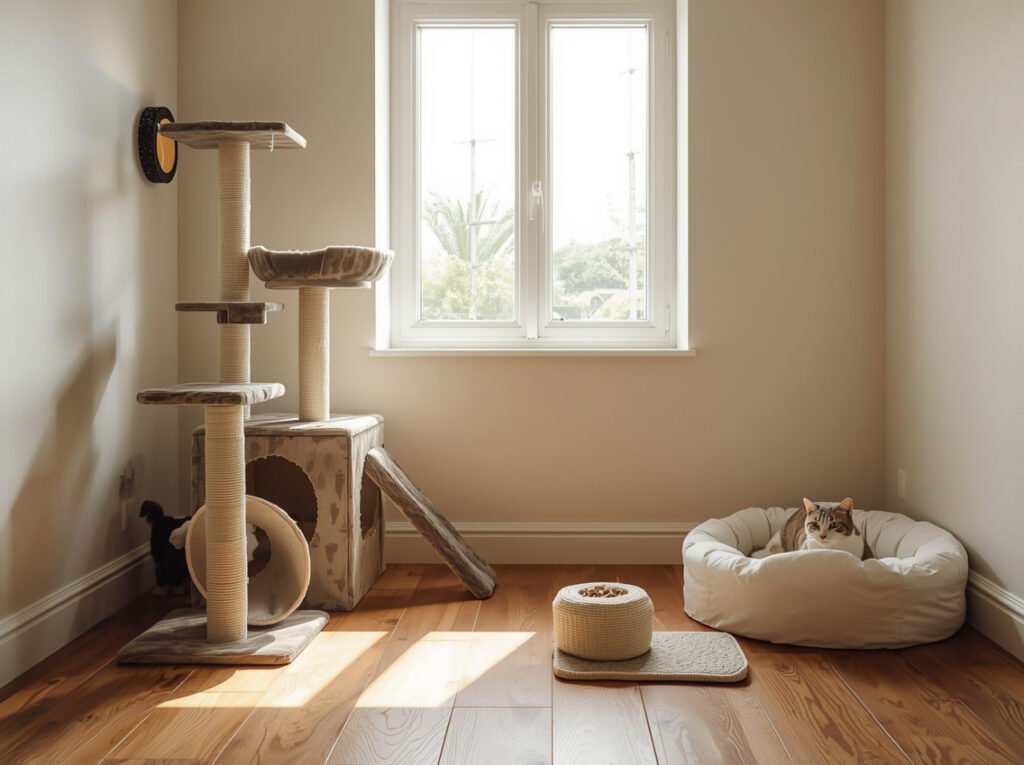
Vertical space is one of the most important components of indoor cat enrichment. A cat tree with multiple platforms, a high observation point, and a scratching post gives your cat access to the elevated vantage points their instincts demand, a retreat space they can claim as their own, and appropriate scratching surfaces. Position it near a window for combined vertical and window enrichment.
9. Catnip and Silver Vine
Approximately 50 to 70% of cats respond to catnip (Nepeta cataria) with a brief period of intense rolling, rubbing, vocalizing, and playful excitement. For the remaining cats who are genetically non-responsive to catnip, silver vine (Actinidia polygama) is effective for an even higher percentage of cats. Offer once or twice per week to maintain the novelty response — daily exposure causes rapid habituation.
10. Training Sessions
Contrary to their reputation, cats are highly trainable with positive reinforcement — particularly for food-motivated individuals. Teaching cats to sit, high-five, spin, or come when called takes less than five minutes per session but provides significant cognitive stimulation, reinforces the human-animal bond, and gives indoor cats a structured source of engagement.
11. Aquarium or Fish Tank
A fish tank provides continuous, unpredictable movement that most cats find endlessly fascinating. Ensure the tank has a secure lid to prevent the cat from fishing. Watching fish is a passive enrichment activity that requires no owner involvement and can provide hours of engagement.
12. Paper Bags and Tissue Paper
The crinkle sound and texture of paper bags (with handles removed for safety) and tissue paper is unexpectedly engaging for most cats. Scatter treats inside a crumpled paper bag or pile of tissue paper and watch most cats spend 20 to 30 minutes investigating, pouncing, and rustling.
13. Outdoor Enclosure (Catio)
For cats who would benefit from fresh air, outdoor sights, and natural stimuli without the risks of free roaming, a catio (enclosed outdoor cat patio) is one of the highest-enrichment investments available. Catios range from simple window box enclosures to large free-standing garden structures. They allow cats safe access to outdoor air, sounds, and stimuli — bridging the gap between full indoor and free outdoor life.
14. Social Play With Other Cats
If your single cat seems lonely and your lifestyle allows for it, a carefully introduced second cat companion provides the richest form of social enrichment available. This is a major decision requiring proper introduction protocols and should not be made impulsively. However, for cats with the right temperament, a compatible companion dramatically increases daily activity, play, and social engagement.
15. Rotate Everything Regularly
The single most underrated enrichment strategy costs nothing: rotation. Put toys away for one to two weeks, then reintroduce them. Move furniture slightly, creating new configurations to explore. Change the location of the cat tree. Place their food puzzle in a different room. Novelty is the most powerful driver of feline engagement, and you can manufacture it indefinitely with what you already own.
Frequently Asked Questions
How much daily enrichment does an indoor cat actually need?
At minimum: two interactive play sessions of 10 to 15 minutes daily plus at least one food puzzle feeding. Beyond this minimum, passive environmental enrichment — window access, appropriate scratching surfaces, vertical space, and available hiding spots — should be part of the permanent home setup.
My cat seems to prefer sleeping to playing. Is something wrong?
Cats sleep 12 to 16 hours per day naturally. However, a cat that shows no interest in play at all, particularly one that was previously playful, may be experiencing pain, illness, or depression worth investigating with your vet. Try high-value interactive toys (Da Bird feather wand specifically) before concluding your cat is simply not interested in play.
Are laser pointers good enrichment for cats?
Laser pointers are excellent for getting sedentary cats moving, but they are frustrating as stand-alone enrichment because cats can never physically catch the point — completing the hunt sequence. Always follow laser play with a physical toy the cat can grab, bite, and carry away.
My cat destroys everything. Can enrichment help?
Destructive behavior in cats is almost always driven by boredom, frustrated hunting drive, or anxiety. A combination of increased daily interactive play, puzzle feeding, and environmental enrichment (cat tree, scratching posts in prominent locations, hiding spots) addresses the root cause far more effectively than attempts to stop the destructive behavior directly.
Conclusion
Keeping an indoor cat genuinely enriched is less about buying specific products and more about consistently providing opportunities for hunting behavior, exploration, vertical movement, and social interaction in whatever forms your lifestyle and home allow. The fifteen strategies above cover every dimension of feline enrichment needs and can be implemented gradually and affordably. Start with the two most impactful changes — daily interactive play sessions and a window perch with a bird feeder — and observe the transformation in your cat’s engagement, activity level, and overall demeanor.