
There is perhaps no single activity more important to your dog’s lifelong behavioral health than puppy socialization — and there is perhaps no activity more consistently misunderstood, underprioritized, or done incorrectly. The socialization window — the developmental period during which a puppy’s brain is wired to accept new experiences as normal — closes around 14 to 16 weeks of age. What a puppy experiences (or fails to experience) during this window creates lasting neurological imprints that shape how they respond to the world for the rest of their life. A well-socialized puppy grows into a confident, adaptable adult dog. A poorly socialized puppy is significantly more likely to develop fear, anxiety, and aggression that affects every aspect of their daily life — and yours.
The Science: Why the Socialization Window Matters
Between 3 and 14 weeks of age, a puppy’s brain undergoes a specific developmental phase characterized by extraordinary neuroplasticity — a period during which new experiences create neural pathways with unusual efficiency and permanence. During this window, the puppy’s default response to novel stimuli is curiosity and approach rather than fear and avoidance. After the window closes (around 14 to 16 weeks), the balance shifts — the brain becomes more conservative, and novel stimuli are more likely to produce wariness or fear in animals that were not exposed to them during the critical period.
This is not absolute — adult dogs can learn to tolerate new things, and good training can reduce the impact of poor socialization — but the neural efficiency of the socialization window is never fully replicated. Experiences during this period shape behavior more profoundly and more permanently than any amount of later training. This is why behavioral scientists and veterinary behaviorists consistently identify under-socialization as the single most preventable cause of fear, anxiety, and aggression in adult dogs.
The Socialization Checklist: What to Expose Your Puppy To
The goal is breadth and positivity — expose your puppy to as many of the following as possible before 14 weeks, ensuring each experience is associated with calm reward and ends before the puppy becomes overwhelmed:
People
- Men, women, children of multiple ages
- People wearing hats, sunglasses, helmets, uniforms, high-visibility vests
- People using walking aids: canes, walkers, wheelchairs
- People with beards, different skin tones, different ways of moving
- People who are taller, shorter, heavier than your household average
- Delivery people, mail carriers, contractors in work gear
Animals
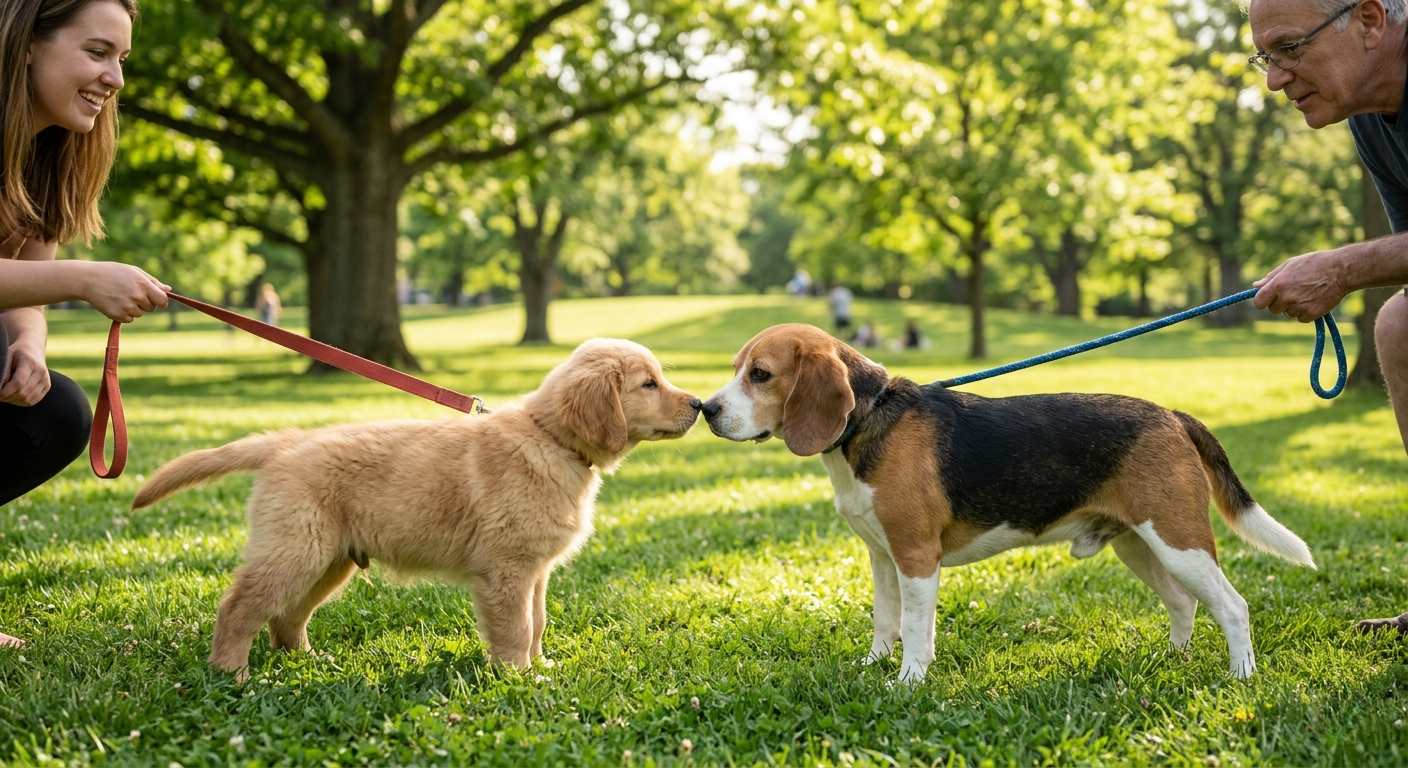
- Calm, vaccinated, friendly adult dogs of different sizes, breeds, and appearances
- Cats (if your household will include cats)
- Other species you anticipate the puppy encountering: horses, livestock, birds, small animals
Sounds
- Traffic: cars, motorcycles, trucks, emergency sirens
- Household: vacuum cleaner, washing machine, dishwasher, smoke detector, doorbell
- Outdoor: lawnmower, power tools, fireworks (sound recordings at low volume during the socialization window)
- Children: playing, crying, laughing loudly
- Thunderstorm recordings played at low volume
Surfaces and Environments
- Different floor types: carpet, hardwood, tile, metal grating, gravel, sand, mud, wet grass
- Different elevations: stairs (up and down), ramps, uneven terrain
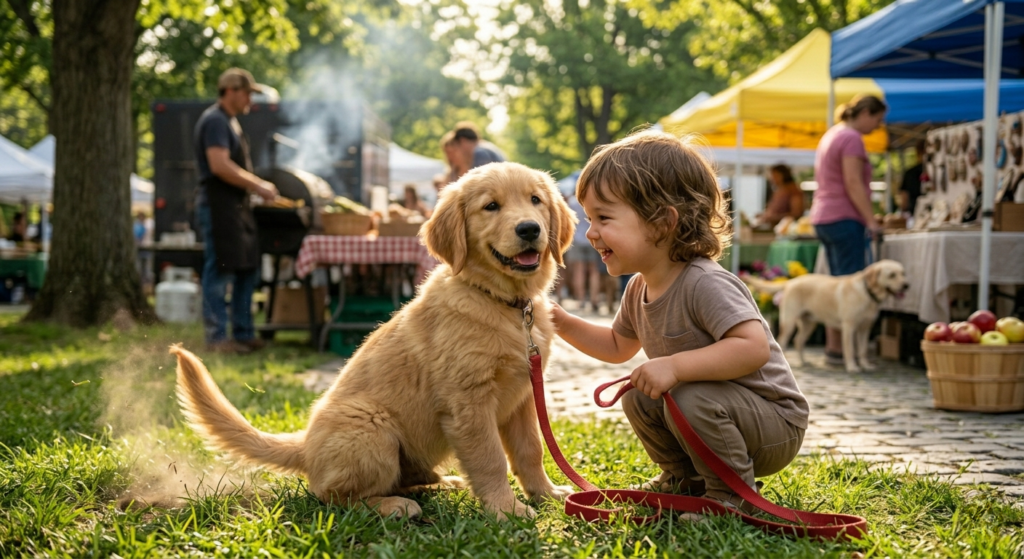
- Outdoor environments: busy streets, parks, markets, pet-friendly stores, car rides
- Veterinary clinic visits (just for treats and positive handling — no procedures needed)
- Grooming salon visits (just for treats and gentle handling by the groomer)

How to Socialize Safely Before Full Vaccination
A common and understandable concern is timing: many veterinarians recommend avoiding public places until the puppy is fully vaccinated at 16 weeks — but the socialization window is already closing at that point. Current guidance from the American Veterinary Society of Animal Behavior (AVSAB) addresses this directly: the risk of under-socialization producing lifelong behavioral problems is greater than the risk of disease exposure in most well-managed environments. AVSAB recommends beginning socialization well before the vaccination series is complete, using these risk management principles:
- Puppy classes: well-run puppy classes that require proof of vaccination (at least 1 dose) and are held in cleaned, disinfected indoor spaces are considered lower-risk and appropriate before full vaccination completion
- Carry the puppy in high-traffic areas: carry rather than walk your puppy in environments where unknown dogs have access (parks, pet stores). The puppy is exposed to all the sights, sounds, and people without paw-to-ground contact with potentially contaminated surfaces
- Vaccinated, healthy dogs: expose your puppy to dogs you know personally to be vaccinated and healthy. Avoid dog parks and situations involving unknown vaccination status dogs until full vaccination
- Choose environments over dog-to-dog contact initially if disease risk is high in your area — sound, surface, and people socialization can be done virtually anywhere
How to Make Socialization Experiences Positive
Exposure alone is not socialization. A puppy who is flooded with overwhelming experiences without adequate positive reinforcement may develop stronger fear responses, not reduced ones. The goal is always to stay below threshold — the point at which the puppy becomes visibly anxious or overwhelmed — and pair every exposure with something the puppy loves:
- Use high-value, novel treats (small, soft, something they do not get at other times)
- Let the puppy approach on their own terms whenever possible — do not force proximity to a feared stimulus
- Watch body language closely: tail between legs, tucked posture, whale eye, yawning, lip licking, or attempting to flee all indicate the exposure is too intense. Create distance immediately.
- Keep sessions brief — five to fifteen minutes of active new-experience exposure is sufficient. Quality over quantity.
- End every session on a positive note — success builds confidence; forced confrontation builds fear
Common Socialization Mistakes to Avoid
- Flooding: exposing the puppy to overwhelming experiences all at once (a crowded dog park, a loud festival) in the belief that ‘more is better.’ This reliably creates fear responses rather than confidence.
- Waiting too long: the most common mistake. Waiting until 16 weeks for full vaccination means the optimal window is already closing. Begin safe socialization from 7 to 8 weeks.
- Comforting anxiety in ways that reinforce it: repeatedly picking up and soothing an anxious puppy in a way that prevents them from self-regulating can reinforce the anxiety response. Calm, matter-of-fact encouragement is more helpful.
- Assuming good experiences happen naturally: socialization is an active, intentional program — not something that happens passively. Create opportunities deliberately.
- Stopping after the socialization period: socialization maintenance throughout the first year and beyond helps reinforce what was established in the critical period.
Frequently Asked Questions
My puppy seems fearful of everything. Is it too late to help?
It is never too late to make improvements, though the efficiency of the socialization window is gone after 14 to 16 weeks. Gradual, positive desensitization and counter-conditioning can produce meaningful improvement at any age. Work with a certified professional dog trainer or veterinary behaviorist for significant fear or aggression.
How many new things should I expose my puppy to per day?
Aim for three to five new experiences per day during the socialization window, each brief and positive. Focus on breadth — variety of experiences matters more than depth or repetition of the same experience.
Should I force my puppy to interact with things they are scared of?
Never. Forcing a frightened puppy to confront a fear reliably worsens the fear response. Always create distance until the puppy is below threshold, then approach the stimulus gradually over multiple sessions with positive reinforcement.
My older dog was not well socialized as a puppy. Can anything be done?
Yes. Systematic desensitization and counter-conditioning, particularly with an experienced trainer, can produce substantial improvement in adult dogs with socialization deficits — especially for mild to moderate fear. Severe fear and aggression benefit from veterinary behaviorist assessment and potentially pharmacological support alongside behavior modification.
Conclusion
Puppy socialization is the highest-leverage investment you will ever make in your dog’s behavioral health. The 14-week window is narrow and does not repeat itself — prioritizing diverse, positive experiences during this period is one of the most important responsibilities of new puppy ownership. Approach it with intention, use high-value positive reinforcement, respect your puppy’s stress signals, and think broadly about the full range of experiences your adult dog will encounter throughout their life. The confident, adaptable dog that results from thorough socialization is a lifetime reward.