
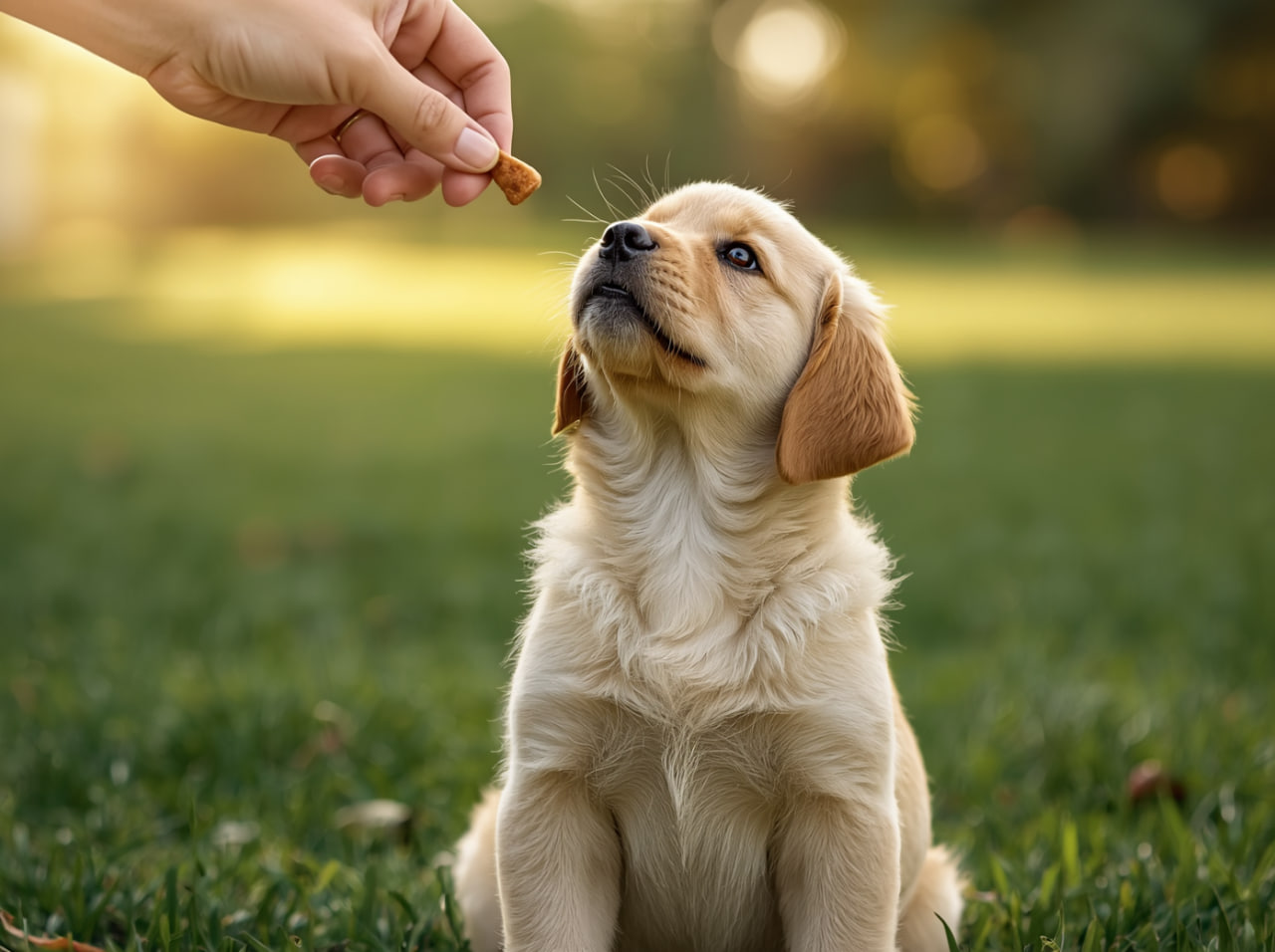
Sit is the first command most puppy owners teach, and for good reason — it is the cornerstone of all future training. Once a puppy learns that their behavior directly produces predictable rewards, every subsequent command becomes easier to teach because the foundational concept is already in place: I do X, good things happen. Beyond its training value, a reliable sit is practically one of the most useful behaviors you will ever teach your dog. A dog who will sit on cue cannot simultaneously jump on guests, dash through the door ahead of you, or bolt toward traffic. Getting this right from the beginning sets you and your puppy up for years of easy, cooperative communication. Here is exactly how to do it.
The Science Behind Positive Reinforcement Training
The training method in this guide is based on positive reinforcement — rewarding the behavior you want to see more of. This approach is not just philosophically preferable to punishment-based methods; it is demonstrably more effective at producing reliable, generalized behaviors with genuine comprehension. Research in animal learning science consistently shows that:
- Behaviors rewarded immediately and consistently are learned faster and retained longer than behaviors punished for errors.
- Dogs trained with positive reinforcement methods are more willing to attempt new behaviors, show lower stress indicators, and perform more reliably in distracting environments than dogs trained with aversive methods.
- The timing of the reward is critical: the reward must arrive within one to two seconds of the desired behavior to form the correct association. Beyond three seconds, the dog does not reliably connect the reward to the behavior.
- High-value, novel rewards produce faster learning than low-value or familiar rewards.
What You Need Before Your First Training Session
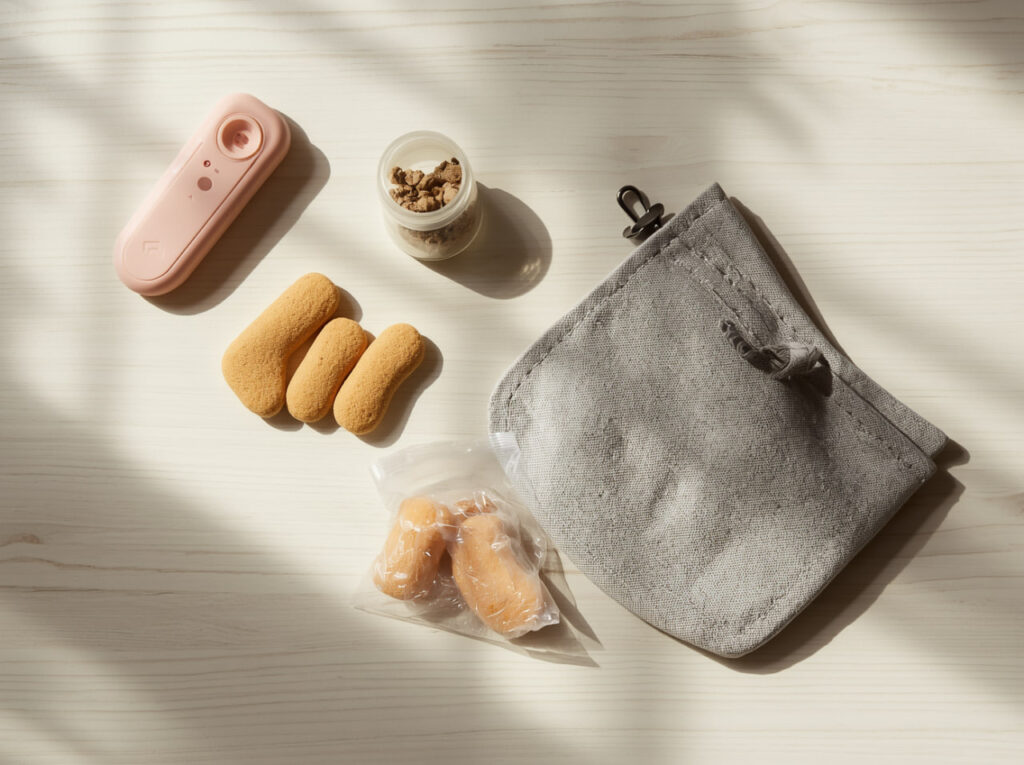
- Small, high-value treats cut into very small pieces: the treat should be small enough to be consumed in one second — pea-sized or smaller. High-value options include small pieces of cooked chicken, cheese, commercial soft training treats, or freeze-dried meat. Avoid dry, hard biscuits that take time to chew, and food your dog encounters every day (novelty increases motivation).
- A quiet location with minimal distractions for initial sessions: a kitchen, hallway, or garden with no other people or animals present. You can add distractions later once the behavior is reliable.
- A clicker (optional but helpful): a small mechanical clicker used to mark the exact moment of the correct behavior — creating a clearer bridge between the behavior and the reward. If you do not have a clicker, you can use a short verbal marker like ‘Yes!’ instead.
- Your puppy’s full attention: train before meals when your puppy is slightly hungry and most food-motivated, and when they have had a chance to exercise and eliminate so they are not bursting with energy or urgently needing a bathroom trip.
Method 1: Lure Training (Best for Beginners)
Lure training uses a treat held in your hand to physically guide the puppy’s body into the sit position. It is the fastest method for most puppies and requires no prior training knowledge:
- Hold a small, soft treat between your thumb and index finger, pinched securely so it cannot be grabbed yet.
- Hold the treat directly at your puppy’s nose — close enough that they can smell it and are clearly interested.
- Slowly move the treat back over your puppy’s head, toward their tail, keeping it close to the top of their head. The treat should travel in an arc that encourages the nose to go up and the hindquarters to go down.
- As the nose follows the treat upward and backward, the puppy’s bottom will naturally lower toward the ground. The moment the bottom makes contact with the floor, say ‘Sit’ clearly and calmly, in a normal conversational voice — just once.
- Immediately open your fingers and let the puppy take the treat, simultaneously offering verbal praise (a warm ‘Good!’ or ‘Yes!’).
- Release the sit position by saying ‘Okay’ or ‘Free’ and taking a small step back to encourage the puppy to stand.
- Repeat the sequence five to eight times, then end the session. Two to three sessions of this length per day is optimal — more than this leads to fatigue and diminishing returns.
Method 2: Capturing (Great for Observant Owners)
Capturing is exactly what it sounds like: you wait for the puppy to naturally perform the behavior on their own, then mark and reward it. Simply carry treats and a clicker (or use a verbal marker) with you throughout the day. The moment your puppy naturally sits — even if it was not in response to any cue from you — immediately click or say ‘Yes!’ and reward. As the puppy begins sitting more frequently in anticipation of rewards, introduce the word ‘Sit’ just as they are lowering into the position. This method produces particularly solid, generalized responses because the puppy figures out the connection independently.
Adding a Hand Signal
Once your puppy reliably sits in response to the verbal cue, introduce a hand signal to give yourself a second channel of communication — useful at a distance, in noisy environments, or for dogs with hearing impairment. The most universally used sit hand signal is an open hand, palm facing up, raised from a horizontal position to approximately shoulder height as you say ‘Sit.’ Practice pairing the verbal cue and the hand signal simultaneously for one to two weeks, then begin testing the hand signal alone. Most dogs generalize quickly once the pairing is established.
Common Mistakes That Slow Down Training
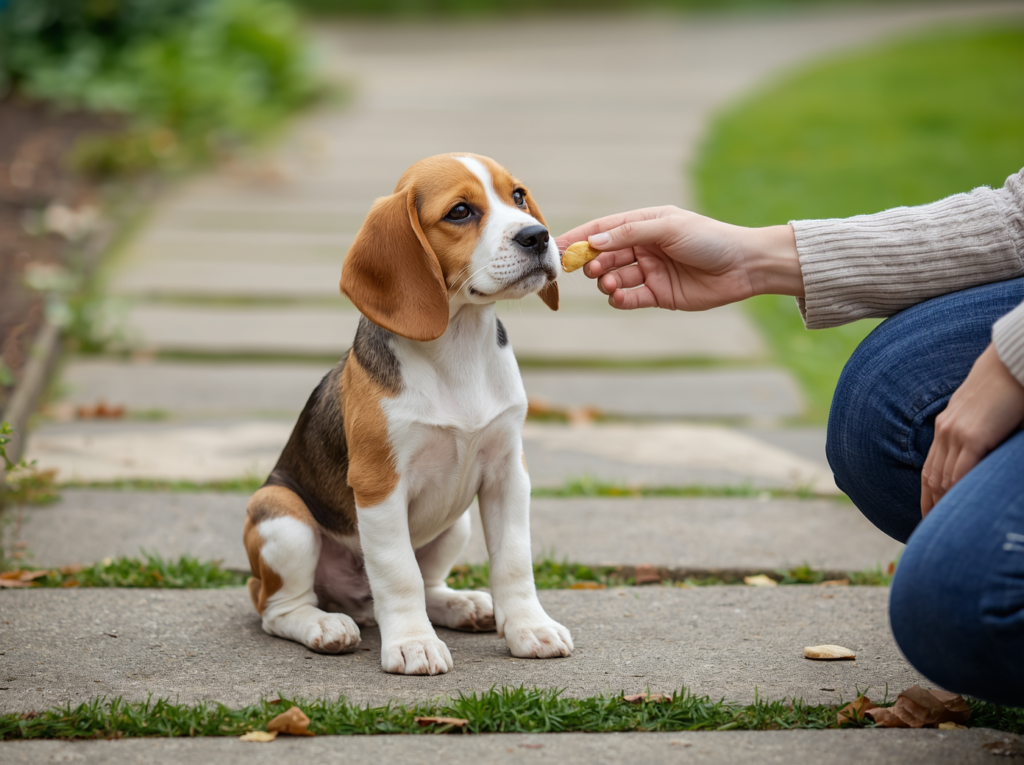
- Repeating the command multiple times before the puppy sits: saying ‘Sit, sit, sit, SIT!’ before the puppy responds teaches the puppy that multiple repetitions are expected before action is required. Say it once, wait up to five seconds, and re-lure if needed.
- Sessions that are too long: puppy attention spans are genuinely short — three to five minutes of focused training is more effective than a 20-minute session that ends in frustration.
- Pushing the puppy’s bottom down: this is common but counterproductive. It irritates the puppy, disrupts the natural movement pattern, and reduces willingness to engage. Always lure, never push.
- Inconsistent rewards: if you sometimes reward with enthusiasm and treats and other times with just verbal praise, the behavior will be slower to establish. Be consistent, especially during the early learning phase.
- Training when the puppy is over-excited or urgently needs to eliminate: a puppy who needs to pee or is bouncing off the walls cannot focus. Exercise and bathroom breaks before training sessions significantly improve results.
- Only training at home: dogs do not automatically transfer commands learned in one environment to other environments — a behavior mastered in the kitchen needs to be practiced in the garden, on walks, at the park, and in every new context where you want it to be reliable.
Frequently Asked Questions
How long does it take to teach a puppy to sit?
Most puppies sit reliably in response to the lure within the first training session. A reliable, consistent response to the verbal cue in familiar environments typically develops within three to seven days of daily practice. Adding distractions and new environments requires additional weeks of practice.
My puppy knows sit at home but ignores me outside. Is this normal?
Completely normal. This is called context specificity — dogs learn behaviors in the specific environment where they are taught. ‘Sit’ at home does not automatically become ‘sit in the park’ without deliberate practice in each new location. Start practicing outdoors in low-distraction environments first.
When should I start training my puppy?
Immediately after bringing them home — from 8 weeks old. The socialization window between 3 and 14 weeks is the most critical period of a dog’s life for learning. Training during this window is exceptionally effective and the lessons learned have lasting neurological impact.
How do I know when to stop using treats?
Treats should be faded gradually once the behavior is reliable in multiple environments, not stopped suddenly. Move from treating every correct response to treating every second correct response, then randomly, then occasionally. Always use treats when introducing the behavior to a new, distracting environment.
Conclusion
Teaching your puppy to sit is more than a party trick — it is the first step in building a shared language with your dog that will serve you both for the next ten to fifteen years. Keep sessions short (three to five minutes), keep them positive, use high-value treats, and practice in multiple environments once the behavior is solid at home. Most puppies master a reliable sit within a week of consistent practice, and from that foundation, every other command you teach becomes progressively easier.