
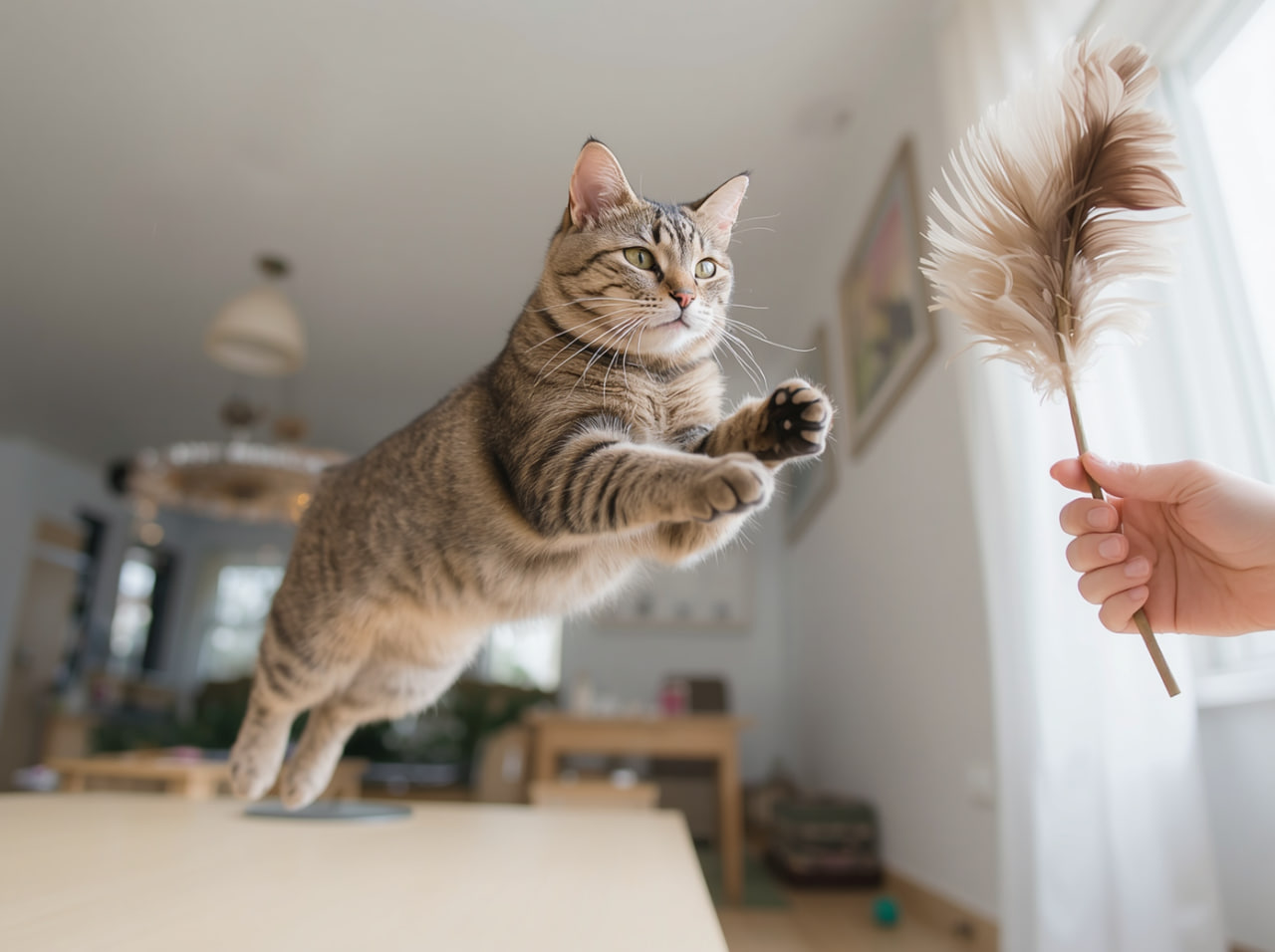
Boredom is one of the most significant and most underestimated welfare concerns for indoor cats. In their natural environment, cats spend six to twelve hours per day engaged in hunting, stalking, exploring, and patrolling their territory. An indoor cat with no environmental enrichment and no structured play is essentially spending those same hours staring at walls — with predictable consequences for their physical health, mental wellbeing, and behavior. The signs of a chronically bored cat are easy to recognize once you know what to look for: excessive sleeping beyond the normal 12 to 16 hours, overeating and weight gain, repetitive attention-seeking, increased aggression toward other pets or family members, and in some cases destructive scratching or compulsive overgrooming. The good news is that enrichment is easy to provide and remarkably effective. Here is a comprehensive guide to the best toys and strategies for keeping indoor cats genuinely engaged.
Why Play Is Different From Exercise for Cats
It is worth understanding what play actually does for cats before discussing specific toys. For cats, play is not simply physical exercise — it is an expression of hunting behavior. The sequence of stalk, chase, pounce, and catch is deeply wired into feline neurology, and completing this sequence is intrinsically rewarding at a neurochemical level. A play session that ends with the cat successfully ‘catching’ their prey satisfies this drive in a way that random movement alone does not. This is why the design of the toy, and crucially how you use it, matters as much as the toy itself. A wand toy manipulated passively produces minimal engagement. The same wand toy moved to mimic the erratic, unpredictable movement of living prey produces the intense, joyful focus that constitutes genuinely satisfying play for a cat.
Category 1: Interactive Wand Toys — The Most Important Category
Interactive wand toys — fishing rod-style toys with feathers, ribbons, or other attachments — are the single most effective play tool available for cats. They allow you to mimic the movement of living prey in a way no automated toy can fully replicate, and the interaction with a human adds a social dimension that intensifies the engagement. Key options:
- Da Bird feather wand: widely considered the benchmark interactive cat toy. The patented swivel mechanism causes the feathers to spin and flutter with a sound and movement pattern that very closely mimics a real bird in flight. Most cats respond with explosive intensity. The feathers wear out and need replacement, but replacements are inexpensive and available separately.
- Cat Charmer ribbon wand: a long, brightly colored ribbon on a flexible wand. The ribbon’s unpredictable, flowing movement is irresistible to most cats, and the wand is nearly indestructible. Good option for cats that prefer a more dramatic, swooping movement pattern.
- Go Cat Peacock feather wand: large natural feathers with a realistic weight and texture. Particularly appealing to cats with high prey drive.
How to use wand toys effectively: move the toy like a living animal — erratic, unpredictable, stopping suddenly, running away, hiding briefly under a blanket or behind furniture. Allow the cat to stalk and approach. Let them catch it regularly — five to ten times per session. End the session by letting the cat fully catch and hold the toy, simulating a successful hunt. Never leave feather wand toys accessible when you are not present — they are supervised-play-only toys due to the risk of ingested feathers.
Category 2: Electronic and Automated Motion Toys — For Independent Play
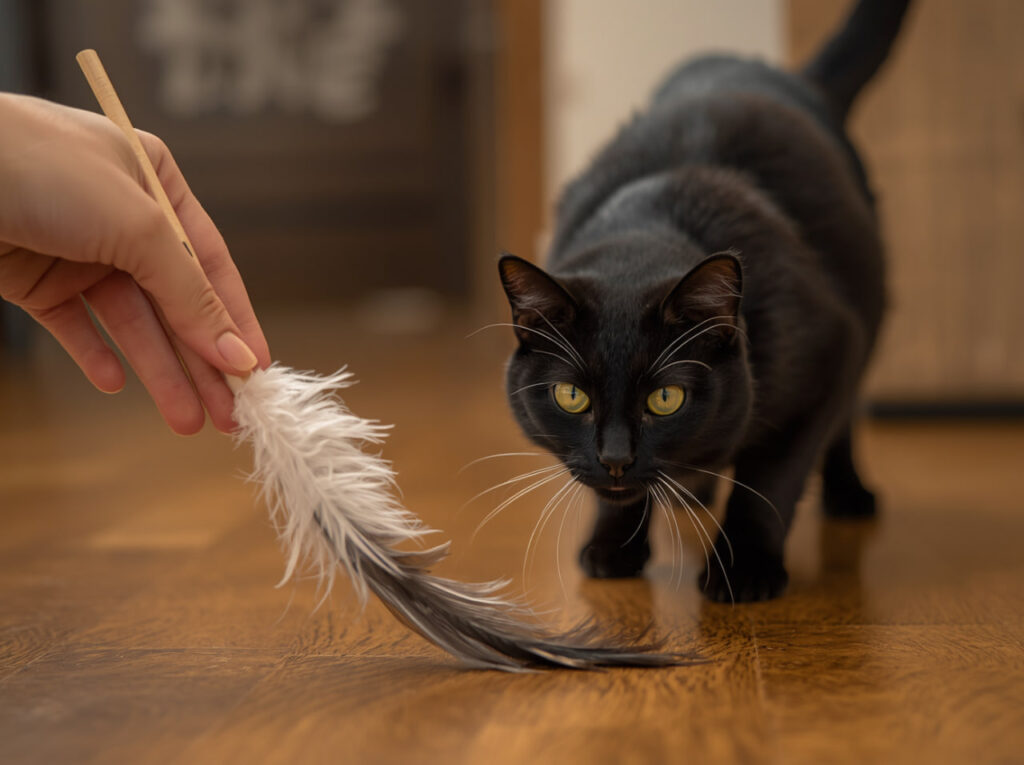
Electronic toys allow cats to engage in independent play when you are busy or away. They vary enormously in quality — the best ones mimic prey movement closely, the worst produce repetitive, predictable movement that cats habituate to within minutes:
- SmartyKat Hot Pursuit: a motorized wand concealed beneath a fabric surface, with the tip appearing at random positions through small openings. The unpredictability keeps cats highly engaged and mimics the sensation of prey moving beneath cover.
- PetFusion Ambush Interactive Toy: rotating motorized feather that pops randomly through holes in a dome cover. Highly effective for cats who love ground-level hunting.
- HEXBUG Nano robotic toy: a small vibrating robot that moves erratically across floors. Many cats engage with this enthusiastically, particularly cats with high small-prey drive.
- Laser pointers (with important caveats): lasers are excellent for getting sluggish cats moving, but they are frustrating if used exclusively because the cat can never ‘catch’ the point. Always end every laser session by directing the laser to a physical toy the cat can grab and bite — completing the hunt sequence. Without this step, laser play can increase rather than reduce frustration.
Category 3: Food Puzzle Feeders — Mental Exercise Through Foraging
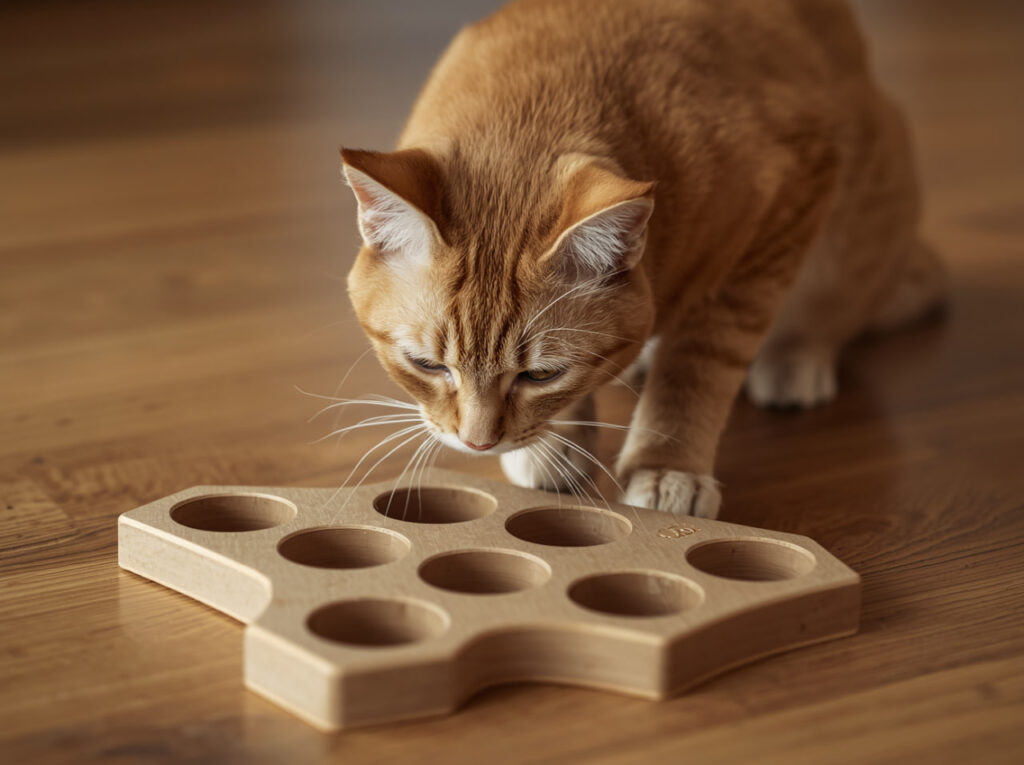
Feeding cats from a standard bowl takes approximately 30 seconds. Feeding from a puzzle feeder takes 20 to 45 minutes and engages problem-solving, spatial memory, and motor skills in ways that conventional feeding cannot. Research in feline enrichment shows that puzzle feeding reduces stress behaviors, supports healthy weight, and is associated with improved overall wellbeing:
- Doc and Phoebe Indoor Hunting Feeder: a set of mouse-shaped feeders that you fill with portions of kibble or treats and hide throughout your home. Your cat must find and open each feeder to get the food. Brilliantly mimics foraging behavior and makes the entire home an enrichment environment.
- LickiMat Slomo: a textured rubber mat designed for spreading wet food, raw food, or yogurt. Slow licking activates calming mechanisms through repetitive tongue movement and takes significantly longer than bowl eating.
- Kong Active Treat Ball: rolling dispensing toy that releases kibble as the cat bats it around. Entry-level puzzle feeder appropriate for cats new to enrichment feeding.
- Trixie Cat Activity Board: a multi-station puzzle with different challenges including pegs, tunnels, and bowls at varying depths. Excellent for mentally active cats who find simpler puzzles too easy.
Category 4: Environmental Enrichment — Creating an Enriched Living Space
The most lasting enrichment investment you can make for an indoor cat is in their physical environment — creating spaces that engage their natural behaviors continuously, not just during supervised play sessions:
- Window perch plus outdoor bird feeder: placing a bird feeder or bird bath visible from your cat’s favorite window creates hours of daily nature-watching entertainment. Known informally as ‘cat TV,’ this is one of the most cost-effective and consistently engaging enrichments available.
- Cat tree with multiple platforms: vertical space is critically important for cats. A well-designed cat tree gives cats the elevated observation point their instincts demand, a safe retreat, and a scratching surface — all in one structure.
- Cat tunnels and crinkle bags: inexpensive fabric tunnels with crinkle material provide hiding, stalking, and exploration opportunities. Most cats engage enthusiastically.
- Catnip and silver vine toys: approximately 50 to 70% of cats respond to catnip with a brief period of intense rolling, rubbing, and playful excitement. For the 30 to 50% who are catnip-indifferent, silver vine (Actinidia polygama) is an effective alternative that a higher percentage of cats respond to.
- Cardboard boxes: free, universally loved, and endlessly versatile. A new cardboard box is genuinely exciting for most cats and provides hiding, exploration, and scratching opportunities.
Keeping Toys Interesting: The Power of Novelty and Rotation
One of the most effective and least known enrichment strategies is toy rotation. Leaving the same toys out permanently causes rapid habituation — the cat stops engaging because the toys have become part of the unremarkable furniture of their daily environment. Instead, keep three to four toys accessible at any time and swap them out every two to three days. A toy that has been stored out of sight for a week is genuinely novel and exciting again when reintroduced. This strategy costs nothing but significantly extends the effective life of your toy collection.
Frequently Asked Questions
Why does my cat ignore expensive toys?
Cats make no distinction between cost and appeal. A cat will frequently prefer a crinkled piece of aluminum foil or a wine cork to an elaborate electronic toy. What matters is movement pattern, texture, sound, and novelty — not price. The most engaging toys for most cats involve feathers, crinkle material, and unpredictable movement.
How much daily play does my cat need?
Veterinary behaviorists recommend a minimum of two 10 to 15-minute interactive play sessions daily for indoor cats. This may not sound like much, but high-quality, engaged play — where the cat is fully focused and actively hunting — is deeply satisfying in ways that passive enrichment cannot replicate.
My senior cat does not play much anymore. Should I be concerned?
Some reduction in play intensity and duration is normal with age. However, a complete loss of interest in all play and activity in a previously playful cat may indicate pain (particularly arthritis) or underlying illness worth investigating. Offer gentler, slower-moving toys and lower-impact activities for senior cats. If the cat shows no interest whatsoever, a veterinary check is worthwhile.
My cat plays hard for two minutes and then walks away. Is that enough?
Cats naturally play in shorter, more intense bursts than dogs. Multiple short sessions throughout the day are actually more aligned with natural feline behavior than one long session. As long as the cat engages with genuine intensity during those two minutes and the session ends with a successful ‘catch,’ the play is likely meeting their needs.
Conclusion
Enrichment is not optional for indoor cats — it is a fundamental component of their physical health, mental wellbeing, and behavioral stability. A combination of daily interactive wand play sessions (the foundation), food puzzle feeding (replacing at least some bowl meals), passive environmental enrichment (window perches, cat trees, tunnels), and toy rotation creates an indoor life that genuinely meets the behavioral needs of a species designed to hunt, explore, and engage with a complex environment. The investment of 20 to 30 minutes of active engagement per day pays dividends in a happier, healthier, and less behaviorally problematic cat.